Showing posts with label travel. Show all posts

Thursday, May 4, 2017

Story "The Sudden" in Wigleaf's 2017 Longlist

Last night I had the writerly blues. After a whole day of being at a standstill with my novel, feeling like I didn’t know anything about anything, and couldn’t write a single sentence worth a damn - I ended up binge watching Forensic Files on Netflix because there’s nothing like disturbing true crime stories to make you feel even worse. Then this morning, woke up to surprising better-than-bacon news: my Icelandic short story “The Sudden” made it on this year’s Wigleaf Longlist!

When it was first published with apt Magazine, it was already a joy to be alongside such beautiful and brilliant work, plus Carissa and Randolph are two of the loveliest, most compassionate and dedicated writers/editors/justice-fighters you’ll ever meet. I’m lucky that my bout of creative pessimism was disproved so quickly (thank you Wigleaf!) but it’s a nice reminder to work through the darkness,  to withhold judgment while holding yourself to a high standard. And make your Netflix choices wisely.

Congratulations to all the Wigleaf Top 50 winners!

Tuesday, November 29, 2016

The Waterfall and the Phone


Ok it’s time for me to write my ode to the Samsung Galaxy S7, because if any cell phone deserves an ode, it’s that one.

It all started with someone’s need to celebrate her birthday this year by staying a night at the Giessbach Grand Hotel in Interlaken (ahem, me). Mike met me in Interlaken that afternoon, and one boat ride and charming old funicular later, we were at the hotel. It’s grand all right: a 19th-century hotel complete with long staircase entrance, sunset lake and a 500-meter waterfall called the Giessbach Falls. We had a little time before dinner so we went to check out the waterfall. It has 14 stages of roaring white water, and at one of the stages, there’s a steel bridge that takes you behind the fall so that you can look down at the hotel through a misty curtain.

Definitely a selfie moment so I took out my cell phone. Because it didn’t have a cover and the back is made of slippery glass, I told Mike, “I’d better not drop this.” Two minutes and six selfies later, I turned around and knocked into Mike’s hand which was holding the phone. The phone fell in excruciating slow motion, a Peter Jackson movie kind of slow. We watched it flip, flip, turn and disappear into the waterfall.

We looked at each other with the exact same thought, “Did that just happen?” Freak out. Quick calculation in my head of the pictures and files I hadn’t backed up yet. Then I remembered I was supposed to give the phone back to my company the next week! We left the bridge and I went to sit down on a boulder to hyperventilate properly.


Mike had the idea that he could try and retrieve the phone. Before I realized he wasn’t joking, he was climbing down the side of the waterfall. I yelled at him to come back, it wasn’t worth it, but the falls drowned me out. I watched his head bob up and down among the slimy black rocks, then he disappeared behind a boulder. I thought, I’m going to lose my fiancĂ© AND my cell phone on my birthday.

Mike’s head reappeared. He was smiling, waving at me. Jacket wet and glasses misty, he skipped back and showed me my phone. He found it in a pool of water along with other people’s dropped objects: a teddy bear, selfie stick, scarf, etc. Turns out that all his mountaineering in Switzerland and hours at the climbing gym were actually useful.
The phone worked! Not a scratch. Screen clear. All systems functional. At this point, all my up-and-down emotions burst out into tears. Mike took the phone and snapped a picture of me sobbing into my scarf. As we walked back to the hotel, I grabbed onto his wet jacket and told him, “I have to marry you.”

So congratulations Samsung, you’ve created a waterfall-proof phone. It gave me a birthday of tears, joys, adventures with water and gravity, heart palpitations and declarations of love. Plus it takes GREAT pictures.

Wednesday, December 23, 2015

Vik and the East Glacier

Iceland Day 2


Driving to Vik was like slicing through darkness. We couldn’t distinguish mountain from ocean anymore and only occasional gas stations lit our way. When we pulled into Vik the town surprised us with its smallness. At first we thought we missed it and soon realized that the church and handful of houses with a sports equipment store were the town. By the time we pulled into our hotel a few miles East of Vik we were ready to make up for the Easyjet morning flight in some sleep dipped in pure Icelandic silence. When I closed my eyes I could still see flashes of the Golden Circle.
The next day we got up at an early bird 10am when it was still dark and jumped at the traditional breakfast at the hotel. M was way too excited about the super salty anchovies while I settled on some lamb pate spread with bread and tiny cucumbers and tomatoes – compact vegetables from their lives in geothermic greenhouses.

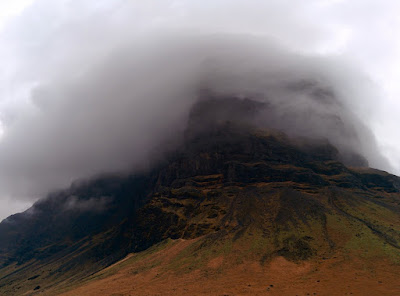
When we started driving the sun was finally lighting our way and we started squealing at every farm animal we found. Just like the tomatoes at breakfast, the sheep and horses looked smaller as if the winds and storms had hammered them down, legs a little shorter but their bodies strong and steady. The birch and juniper trees too looked like defiant dwarves. We soon passed through miles of volcanic fields. I had never seen a plain so flat, so uninterrupted, except for the occasional mangled lava rock deposited by melting glacier. Then the waterfalls started showing up, one after the other, there were so many we lost count. Thread after thread of white water cutting through sudden mountains who wore clouds like veils. Once we got close to the Glacier Lagoon, the blue ice started filling in the mountains.

The Ice Caves


As soon as we met our tour group at the Glacier Lagoon Jokursarlon in Eastern Iceland, we realized we were severely under-camerad. Almost every person had a professional camera with massive lenses and a tripod tucked under the arm. My iPhone seemed like the smallest kid at the playground. We piled into the massive truck with chunky, oversized wheels that would take us across rocky terrain to the mouth of the cave.

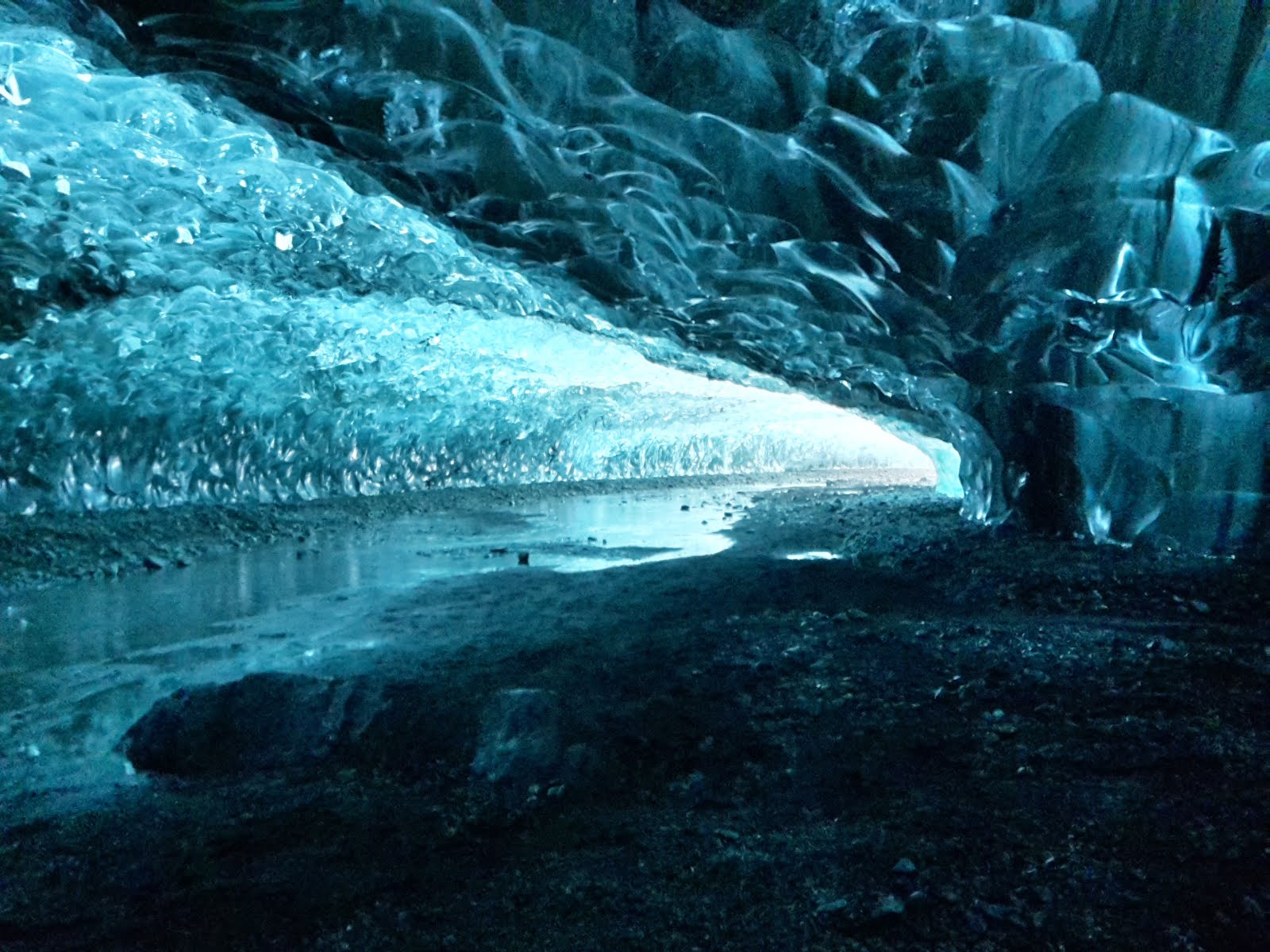
What surprised me at first was all the dirt: sandy, dark, volcanic dirt that coated the glacier where you couldn’t see where earth ended and the ice began. But as we drew closer, we started seeing more of that brilliant blue. They say the bluer the ice the older it is, as the color is formed from snow that has been compressed into the glacier, crushing away water and air bubbles to make room for blue-reflecting crystals.

The guide was more like a babysitter. He made sure we kept our helmets on and stayed away from the risky areas of overhanging ice that might collapse. He led us into the cave, dark at first then giving away to palatial arches of sapphire. It seemed impossible that these ice crystals could be so bright when lit by nothing but sunlight, so complex in their facets when cut only by nature.

On the other side of the cave there was a large clearing in the glacier which led to other caves off-limits to us. Some holes in the ice spouted water, others took on recognizable shapes like cartoon hearts. We were able to scramble on top of one lump of ice and watch the small dark birds circle above. As we left, I was startled to find the remnants of a bird that must have slipped, fallen – a pancake of feathers and bones flattened by ice.


Swimming with the Icebergs

“I’m going to swim to that iceberg,” said M.

“I’ll hold your socks,” I said.

We had been circling around the beaches and the glacial lagoon, walking through the chunks of ice shed by the glacier. By the entrance to the glacier, there was a big blue iceberg with some ice ledges floating near the shore. I knew M was serious when he picked out one of these ledges to swim to, and I only made a half-hearted attempt to talk him out of it. A few years ago we had participated in the Coney Island Polar Bear Swim. I couldn’t feel my feet for the next two weeks; he was as warm as a bear.

We waited until most of the other tourists had left, then M stripped off his clothes, handed me his socks and splashed into the ice water. Just watching him made me shiver as if I could feel the water on my own skin. He quickly splashed to the flat piece of ice, lounged on it like an 18th century French boudoir painting, I took the photographic evidence, and he splashed his way back.

“It wasn’t that bad,” he said.

A few meters down, a couple laughed and shook their heads.

Even though I only watched the insanity of swimming of icebergs, I was dying for some warm, homey dinner by the time we got back to Vik. Luckily we found the Halldorskaffi restaurant, with its string lights, fireplace, menu of grilled fish and burgers, was like eating at your Icelandic-American grandmother’s house.


Travel tips
For the complete 4-day Iceland itinerary and map, click here.
  • How to get there – Vik is in Southern Iceland, a 2hr15min drive from Reykjavik. Don’t underestimate the distance! The East Glacier ended up being much farther from Vik than we thought, a 2hr30min drive further East.
  • Tours - When booking tours, note that several companies simply repackage the same tour, you ultimately attend the same tour as others but might be paying a premium. The Ice Cave Tour seemed more geared for photographers. If you’re looking for something more active, try one of the ice climbing tours.
  • Where to Eat – in Vik have a hearty meal in the sweet and homey Halldorskaffi.
  • Where to Stay – The Country Hotel Katla is located slightly outside of Vik. It offers basic but clean rooms that are generously heated for an affordable price. They also have a great Icelandic breakfast which starts off your day with a full stomach.


Friday, August 21, 2015

The Hobbits of Switzerland


We went on this gorge-ous hike near Neuchatel and kept expecting elves to jump out at us, gracefully of course. I mean could this get any more Lord of the Rings?! And then 30min later it did…


We found Bilbo Baggins’ house! And Frodo’s! That’s it, Middle Earth is in the Gorges de l’Areuse of Switzerland.

Now I’m thinking of starting a booktag called #booksinreallife for famous books come to life in real places/people/situations. What does everyone think?

Monday, August 10, 2015

Speculating in Corsica

The first time I read Jenny Offill's book Dept. of Speculation, I raced through the fragments that built to a very moving novel. This time I brought it to my Corsica weekend to flip through and savour as bite-sized prose poetry. This picture was taken at the Iles Sanguinaire or Bloody Islands though they didn’t look as red as their name that day. Maybe I was just dazzled by all the book blue on Mediterranean blue.

Lines like these made my heart stop: "Sometimes the husband and wife run into each other in the park across the street. He is there to smoke, she to stare at the trees. He buttons the three buttons of her coat. He loves me, he loves me not, he loves me, she thinks."

Monday, February 16, 2015

The Golden Circle

Iceland Day 1


However many minutes of crank-back sleep we could get on the Easyjet flight and its immovable seats was enough as soon as we stepped off the plane. Maybe it was my confusion between Celsius and Fahrenheit, but I imagined a warmer wind when stepping out into the airport parking lot. The Icelandic wind was knife sharp and my scarf poorly worn.

Once we got into the warm SUV and started driving on those clean smooth roads, the excitement started bubbling. The sun was just rising a lazy 10 o’clock and the flatness of the asphalt beneath our wheels was matched with the flatness of the plains, the pools, the snow, everything except for a few mild mountains covered in winter-browned grass. The whole landscape looked as if it had been ironed down, which is not far from the truth since ice used to be the blanket on this once underwater island.

We stopped near a timid lake to watch the colors rise. It’s a different sky here. A bigger, bolder, more complicated sky. I couldn’t remember the last time I saw a sunrise, being the opposite of a morning person, and I thanked the tilt of the earth for the streaks of gold and pink and bruised fire smearing the above. So happy so happy so happy rang through my head as we headed to the first stop of the famed Golden Circle of Icelandic bests.


Thingvellir National Park


It wasn’t until we neared Thingvellir that the ground began to unflatten and take hard-edged shapes. Here lies the continental drift between the Eurasian and North American tectonic plates. You wouldn’t think it at first from the peaceful pieces of snow encircled by a river and the dwarf pine trees dotting the Alpingi – an ancient place of assembly to decide and enforce Icelandic law since 930 A.D. Walking through the stacks of basalt columns that enclose the drift, it is easy to imagine how this gap between continents moves farther apart or closer, its little moods setting off earthquakes.

Crunching through the snow, we saw some scuba divers just finishing a dive into the fissure and we wished we had the time to join them. Our only taste of the clear water were a few coins thrown into the gap, adding to the years of wish-carrying coins that gave the brown rocks sparkling scales. We walked past the fissure to reach a small waterfall that still roared quite a bit. The white frothy water and blue snow interrupted by rigid rocks made it unlike any other waterfall I had seen, though little did I know seeing the Gullfoss later would smash this one right out of the water.


The Geysir


When we drove to the geysers which must be of a lower altitude, the snow quickly began to fade, revealing more and more of the brown hair-tufts of grass. You could smell the rotten-egg perfume of sulfur right away. There the grass regained some of its green in the fumes and constant mud. Before heading to the steaming pools, we first stopped in welcome center where an exhibit had some geological and historical tidbits. We learned that we were about to see the very first known “Geysir,” which is so famous it doesn’t need a last name like Prince, Cher and other legends. In fact the word itself comes from the Icelandic verb “to gush.” Its days of frequent outbursts and maximum height (170m) have passed. For awhile it was blocked because of tourists throwing rocks into the throat to try and trigger it. Ah tourists, wanting to order up natural wonders at the click of a button. I found though that the extreme, stark beauties of Iceland was nice reminder to enjoy nature by flowing with it, not package its pieces.

First we looked at the smaller geysers, some with blue water steaming, others where you could see down the throat that goes into the center of the earth. Here too, visitors had strewn their wish-coins. The Strokkur erupts the most frequently so we waited by that one instead of the main Geysir. Soon enough, the gray water started turning blue, swelling as if there were a pair of lungs underneath, and it formed a bubble that grew and grew until the explosion of foamy white water with the ooohs, aaahs and camera clicks.


Gullfoss


I was expecting a waterfall but not a WATERFALL. The Gullfoss is a massive roar of water filling what looks like the aftermath of earth itself cracking open. A powdered sugar sprinkling of snow on top and this is the loudest most delicious waterfall I’ve ever seen. Walking on the many ledges separated by two ropes, gazing at different layers of the falls, it was hard not to fear we were too close, a wrong step while clicking away pictures could mean a literal fall. We met a nice woman though who froze her fingers trying to snap the perfect picture of us while she balanced her own tripod under the armpit. That was our first inkling that Iceland is heaven for photographers.


Kerid


Already the air was gray when we got to the Kerid. In December the sun sets by 5pm and we were just on the cusp of darkness, but we had to go see this volcanic crater. The Kerid looked like a round black mirror at the bottom of a bowl. The snow glowed, threaded by black rocks and spidery branches. Looking more closely as we took the top path around the crater, I could see that the volcanic rocks had flecks of red too. Back near the entrance, we found a path that wound inside the crater and took us down to the lake. The darkness had become almost touchable though, and my steps had little to do with sight. They were mostly based on faith. The water was black cold. There was a lovely dark serenity that wrapped around you – only interrupted when M pretended to throw me in when taking a picture, and the other tourists taking the picture called us “so American.” It was hard to detach ourselves from the beautiful silences of Kerid, but we made our way back to the car to drive along the Southern coast to Vik for a solid night’s sleep.

Travel tips
For my complete 5-day Iceland itinerary, click here.
· Where: The Golden Circle consists of Thingvellir, Geysir, Gulfoss and other sights, is very much doable in one day and gives you a nice sampling of Iceland. Clockwise or counter, it’s up to you.
· When: If you start with Thingvellir it’s a 45min drive from Reykjavik airport.
· How to get around: There are bus tours but driving is surprisingly easy. Roads are in great condition, rental cars come equipped with snow tires in winter so no need to rent a four-wheel drive unless you’re planning on going off-road.
· Bring: Warm, windproof, waterproof clothes and boots (especially in winter!) and be sure to have a GPS when driving.
Links:

Monday, December 29, 2014

Castle Climb in the Fog


Fort l’Ecluse, France

The weatherman had promised unusual sun but all we got was a fog that deepened and thickened throughout the day. We still drove to Fort l’Ecluse as planned though, a trunk full of ski helmets, harnesses and the springy lanyards which are supposed to keep us firmly attached to the mountain. Close to the quaint French village of Collonges, Fort L'Ecluse was built in the 19th century by the Duke of Savoy to command the Rhone. The lower fort consists of a narrow tower staircase embedded into the mountain and leads to the larger, upper fort which overlooks the river. The parking lot was empty except for one man with two dogs and a pet sheep. From the car, it was only a few minutes hike to the start of the Via Ferrata. 

Via Ferrata is italian for “iron road” and it means what it says. Mainly found in Europe, they are constructed paths of steel steps, rings, ladders and ropes for an easy ascent to heights that normally would only be attempted by superhuman climbers. Made easy for the body but not the mind. Most people have the stamina and strength to do it: psychological limits are tougher to overcome. All your senses will bombard you with panic and flare guns. “Don’t do this!” your eyes will scream as you stare at the thousand-meter drop, the slanted rocks, unable to calculate how much farther you have to go, and how far you would fall. You have to have faith in the metal clips connected to steel rope connected to anchors drilled into rock, which together keep you from dropping from the mountain.

At first the climb was straightforward: the steel rungs made a neat vertical line up the cliff. The steel was cold and wet, which made my step a little more hesitant and my hands aching for waterproof gloves. A little further and the fog had swallowed us whole. Other than the immediate rocks and tufts of trees, we couldn’t see anything beyond the mist. We knew there were the castle walls and secret staircase, we knew there was a river somewhere and hundreds of meters of elevation, but we saw nothing but gray. It was a dewy and comforting blanket, which dampened my fears since I couldn’t perceive the depth of falling should a hand or rope fail.

Somewhere in the middle, the climb became more difficult with wider steps, scrambling up rock edges, calling on upper body strength I didn’t have. One section has you stepping on nails over sheer nothing to get from one chunk of mountain to the other and a sharp overhang that needs a broad swing of the arm to get back to vertical. In the fractured seconds I allowed myself to look down, I was amazed at how one toe on a tiny steel nail was the only thing between me and the ravine. Friends laughed at me when I raced up the tough spots, not giving myself any time to think, to build fear, and then crumbled to a whiny girl at some muddy slopes on the easy walk to the bridge.

Before arriving at the bridge, we first had to cross a wooden beam without handrails, which had me muttering, I don’t like this at all, why the hell did I want to do this, never again, I like the idea of adventure, less the actual doing... Then the monkey bridge came into view. The word “bridge” is used liberally here as it is nothing more than two steel wires, one for hands and one for feet, stretched across to the fort. The incessant wobbling and acute feeling of being naked in the air was unsettling at first, but soon I found it an easy slide over.

While the fog was close and personal during the climb, opened up at the fort, it was a billowing mass, rolling over the crumbling turrets, pouring through the narrow windows, lining the wet grassy paths. The stone walls, already softened by history, were now blotted and dimmed to a fantasy. Did we accidentally climb into another world? Chocolate and dried mangos revived my cold fingertips, made a damp fire in my chest, while we walked between the gray walls with flecks of white, stepping on weeds and grass hardened by autumn, passing under the tragedy of vines and blackened moss.
 
Of course M and T had to find a way inside the iron-locked fort and with some scrambling up a hill and squeezing through a window, they managed. Inside, they said, the fog was filling and filling the vast loneliness of the castle. There was an entrance to the long staircase down the mountain but they knew the exit would be locked. Instead, we took the hiking path down, a conventional loveliness of fall leaves and dewy spider webs, leaving the ghosts behind us with every muddy step.

  Travel Tips
·       Where: Fort L’Ecluse is a 30min drive from Geneva, makes for an easy day trip. See map.
·       Duration: Ascent is about 1hr 30min, hike down another 30min
·       Bring: Helmet (climbing or ski), harness, lanyard, climbing gloves (especially if it’s cold), sneakers or hiking boots not climbing shoes
·       Links: